
Africa donation bike container #3 has come quite far on its journey from San Rafael, California. As far as Johannesburg, South Africa to be exact. Yet, as we've so often found with our philanthropy projects in Africa, unexpected complications have a habit of tossing a monkey wrench into the gears exactly when you think things are going smoothly.
This time striking South African rail and port workers have stopped the container of 474 bikes in its tracks (so to speak). It's awaiting loading onto rail transit in Jo-burg, in order to head to Mike's Bikes Sister Shop Jonmol Bicycle Services in Gaborone, Botswana. The strike is now in its sixth day, and we're hoping along with Bones and the Jonmol crew that the strike reaches a resolution posthaste. As we've experienced first-hand, the people of Gaborone need bikes!
Showing posts with label Sister Shop in Botswana. Show all posts
Showing posts with label Sister Shop in Botswana. Show all posts
Saturday, May 15, 2010

Friday, May 14, 2010
The story of the loading of our third container of Africa bikes - told in a minute and a half
How to load 474 Bikes on a 40ft. Shipping Container from Mike's Bikes on Vimeo.
(Imagine the theme music to Benny Hill)
Back in March, we loaded 474 bikes generously donated by our customers into a shipping container bound for Gaborone, Botswana. Our third Africa bike container to date, this one is headed to Jonmol Bicycle Services, our first Africa Sister Shop that was established in 2008.
Thanks to the wild success of Jonmol, there are hundreds of people now using bicycles for transportation in Gaborone. The only drawback to getting the bikes out so quickly is that now Jonmol's proprietor Bones is in dire need of another round of affordable bicycles to offer to his community. Once again the customers of Mike's Bikes have stepped up, and this container was packed with more bikes than any we've sent to date!
Monday, November 9, 2009
Dialing it in
Final flashback, three days ago:
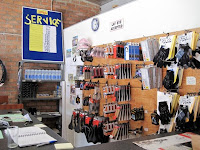
Back at Bones' shop, we had work to do. Jerry, Bones, Matt, Ken, and I tore into the project of making Bones' shop a more inviting retail space, and one that would get more people out on bikes. We unpacked four big boxes of parts and accessories that we were donating to Bones and that were such a nightmare at customs. We used them to fill the racks behind his counter space and under the service counter, neatly presented and organized. We also went through pricing with Bones on all of these items, striking balances between what the local people could afford and what Bones needed to make to keep the lights on.

As we worked a very tall man came in with a very big bike. He introduced himself as David and we quickly learned that he is someone we had been emailing with for several weeks. David is an American who is living in Gaborone with his family and working on aid programs for several months. He was an early customer of Bones', and he gave us an idea of what it was like to bicycle for transportation in Gabs. He assured us that it was more than viable to get around on a bike, and said that after getting a child seat from Bones one of the best experiences he has had in Gaborone is that of riding around town with his son on the back of his bike. He says that no one here has seen this and people fall over themselves to look and smile when they do.

Then it was bike time. We wanted the bright space at the front of the shop to have an enticing display of the bicycles in Bones' inventory, looking like they were eager to take their new owners to work, to school, or to health care by dicing through the traffic jams and leaving frustrated drivers in their wake. We set to cleaning and tuning every bike Bones had for sale. We installed kick stands and lined them up with price tags clear as day on each one.

While we were in the middle of this, Boz stopped by for a brief visit. He was a contracting consultant working for the government of Botswana with the purpose of finding worthy and viable local businesses who would sustain themselves, grow, and most importantly to the government, employ local people. Bones' shop was a natural fit, and Boz sat down with Matt and Ken to show them the methods in which he was training Bones to deal with the financial side of Jonmol. We were impressed that cost of this federal program, which was covered primarily by the diamond industry, was being used in what seemed to us to be the perfect way. To mentor local businesses, help them find success, and create jobs for the people in their communities. We found Boz and his methods for training Bones to be top-notch, and may even work with him directly to find future candidates for Mike's Bikes Sister Shops.

The final thing that happened that afternoon at Jonmol was a pow-wow with the entire crew. Matt led the discussion and it focused on the importance of good service. He stressed the fact that every bike on the sales floor needed to be perfectly tuned and presented, saying that these bikes should be so good that the Jonmol guys would "want their mothers to ride home on them." Best practices were discussed with regard to repair services, and then finally some grassroots marketing. We dropped off 2000 stickers with the Jonmol logo and contact info for the guys to do a little guerrilla marketing. We were thrilled to hear that Jonmol had already organized and sponsored several group riding events, including the Enviro Cycling Challenge which benefitted a local charity and apparently had an overwhelming turnout.

In the some of the short remaining time before we bid farewell to Bones and the boys at Jonmol, we discussed ways that they could push these grassroots efforts even further. Not only would this show of public bicycle force promote their own business, but it would help make the bike become more 'cool' in Gabs, and in time might help the people of Gaborone to understand the freedom, mobility, and simple joy that only a bicycle can give.


Bicycle retail 101. Or maybe 37.
Still flashing back, three days ago:
The reason we had come to Gaborone was not to tour Jonmol Bicycle Services, visit Bones, or even to check in for a face-to-face update. We had made this excursion on our Africa trip to try to identify the challenges he was having with his shop after a year of existence, and to do that best that we could to help him solve the problems and become self-sufficient.

During our look around the place, we talked with Bones and Jerry about some of the difficulties they were having at the shop. The first thing on our minds was to get a sign out front as soon as possible. After a little nosing around, we found the old sign that we had made for the shipping container which had brought so many people to Bones' shop while we had unloaded and set up last year. Arrangements were made immediately with his landlord and a metalworker next door to mount the sign at the entrance to the alley. One down.
In the front room, there was a new 16" kids' bike that had come with a tire that had a huge gash in it. Since the only distributor available to him was out of that size, Bones was stuck with the bike as dead inventory. We'll help by sending some of the tires with our next container of donation bikes, but that will take time to get to him. He also had repair bikes requiring 27" tires that were stuck in limbo because of the same supply problem, which again we pledged to help supply them during the container shipment.

These issues with his distributor brought us into a conversation of stocking levels with Bones. We stressed to him that since he now had a little capital from the sale of the donation bikes, he would need to identify parts that he did not have in advance of needing them whenever possible, so that he could order when the distributor had stock and not be stuck when they did not. We helped him get together want-lists and assisted with some rudimentary stock planning and scheduling. This way he would be best equipped to keep the bikes in Gabs rolling with the service they needed. This was the only way for the bikes to be of use to their owners, thereby making them a viable transportation option for the people of Gabs.
After seeing the defective tire on the kids' bike, we did a little survey of what bikes Bones had for sale. The good news was that he had sold completely through the entire lot of 404 donation bikes from our first bike drive, which is extremely gratifying because it literally means there are over 400 more cyclists in Gabs than there were before our Africa Bike Drive. The bad news was that distributor limitations and costs meant that Bones' bicycle stock was now fairly low and priced higher than the original load of second-hand bikes.

He had about six kids' bikes in stock, which he told us would likely move quickly with the Christmas season approaching. All of them were leaned up against each other, untuned, and with cardboard and bubble wrap all over them. His most basic adult bike was a Raleigh Rhino, which was an ideal bike for Gabs, because it was less expensive than almost anything else available and was very durable and useful with its single-speed drivetrain and full fenders and rear cargo rack. In short, a very similar transportation bike to what you see in cities across the U.S. Bones had a couple of Rhinos in stock and also a few Raleighs that were a step up with full ranges of gears, aluminum frames, and front suspension. Not a one of them was in an acceptable state of tune, however, with packaging still attached, brakes, shifters, and handlebars improperly positioned and adjusted, and parked in corners of the back room or hanging up out of view. The final bikes we found in his stock were some Humber-style bikes from Raleigh, which are the classic full-fender heavy steel bikes that are popular in European city centers. These were quite beautiful, and almost as inexpensive as the Rhino, but one wouldn't have known they even existed because they were hanging up in a dark corner and wrapped up in packaging. Just a single one of Bones' entire stock of bikes was priced.
At this point we felt we had to show Bones the importance of presenting his wares in such as to add value to them. He needed to have the people who walked through his door get excited about riding bikes, and to convince them that a bicycle was a better buy than a month's worth of cramped, slow, noisy, combi-van transit rides. I was surprised when the guys at Jonmol told me that in rapidly-developing Gaborone, a bicycle needed to not only appear to have value, but also needed to actually be seen as cool. This brought me back to the days before hipsters, when urban bike riding still had to overcome that ages-old 'cool' stigma. Ah, memories.
To help with this, we brought Bones to the mall. Gaborone has indoor malls, and though most of the population can't afford to shop at them, everyone thinks that what is sold there is cool. Walking through the mall which looked very much like one or our malls in the States, we showed Bones the ways in which these stores presented their product to the buyer. Clean, shiny, front-and-center in bright window displays, and priced so that anyone would know the value of the products simply by looking at them.

Over coffee at the mall, Ken and Matt went over Bones' financial records with him, and gave him lots of coaching from the retail 101 playbook. Supply-and-demand, profit-and-loss, how to control inventory and record wholesale costs and sales were all discussed. This was a lengthy talk, but we were pleased to learn that a business development representative from the government of Botswana had been mentoring Bones on running Jonmol in the recent months, and would continue to do so. His name was Boz and we would later have a fascinating meeting with him at the shop.
The whole purpose of our Africa Bike Drive project in the first place was to get Bones and Jonmol Bicycle Services to a place where they would be completely self-sufficient, and thereby enable the people of Gaborone to have a continuing and long-term source of bicycle transportation. After taking a hard look at the numbers, we were pleased to see that much progress had been made. But we learned that there was still a ways for Bones to go before he would be able to cover all of his costs. Since the container bikes had been sold, he was moving bicycles at the rate of just 10 per month. He would need to double or triple that to ensure the long-term viability of his shop, and we came away from the morning with the knowledge that at the very least many of the seeds of his success had been planted.
The reason we had come to Gaborone was not to tour Jonmol Bicycle Services, visit Bones, or even to check in for a face-to-face update. We had made this excursion on our Africa trip to try to identify the challenges he was having with his shop after a year of existence, and to do that best that we could to help him solve the problems and become self-sufficient.

In the front room, there was a new 16" kids' bike that had come with a tire that had a huge gash in it. Since the only distributor available to him was out of that size, Bones was stuck with the bike as dead inventory. We'll help by sending some of the tires with our next container of donation bikes, but that will take time to get to him. He also had repair bikes requiring 27" tires that were stuck in limbo because of the same supply problem, which again we pledged to help supply them during the container shipment.

After seeing the defective tire on the kids' bike, we did a little survey of what bikes Bones had for sale. The good news was that he had sold completely through the entire lot of 404 donation bikes from our first bike drive, which is extremely gratifying because it literally means there are over 400 more cyclists in Gabs than there were before our Africa Bike Drive. The bad news was that distributor limitations and costs meant that Bones' bicycle stock was now fairly low and priced higher than the original load of second-hand bikes.

At this point we felt we had to show Bones the importance of presenting his wares in such as to add value to them. He needed to have the people who walked through his door get excited about riding bikes, and to convince them that a bicycle was a better buy than a month's worth of cramped, slow, noisy, combi-van transit rides. I was surprised when the guys at Jonmol told me that in rapidly-developing Gaborone, a bicycle needed to not only appear to have value, but also needed to actually be seen as cool. This brought me back to the days before hipsters, when urban bike riding still had to overcome that ages-old 'cool' stigma. Ah, memories.
To help with this, we brought Bones to the mall. Gaborone has indoor malls, and though most of the population can't afford to shop at them, everyone thinks that what is sold there is cool. Walking through the mall which looked very much like one or our malls in the States, we showed Bones the ways in which these stores presented their product to the buyer. Clean, shiny, front-and-center in bright window displays, and priced so that anyone would know the value of the products simply by looking at them.

The whole purpose of our Africa Bike Drive project in the first place was to get Bones and Jonmol Bicycle Services to a place where they would be completely self-sufficient, and thereby enable the people of Gaborone to have a continuing and long-term source of bicycle transportation. After taking a hard look at the numbers, we were pleased to see that much progress had been made. But we learned that there was still a ways for Bones to go before he would be able to cover all of his costs. Since the container bikes had been sold, he was moving bicycles at the rate of just 10 per month. He would need to double or triple that to ensure the long-term viability of his shop, and we came away from the morning with the knowledge that at the very least many of the seeds of his success had been planted.
One year on: a tour of Jonmol Bicycle Services
Flashback to three days ago:
For those of you that weren't tuned in last year, we established Jonmol Bicycle Services with Jon "Bones" Moletsane in Gaborone, Botswana, with a lot of hard work, a lot of investment, and 404 bicycles generously donated from our customers. Though Ken and Matt were in Gabs to help Bones create the shop last year, this was the first time they had been back since, and of course it was the very first time I had ever seen the shop.
What struck me initially about Jonmol was nothing. Literally nothing at all.

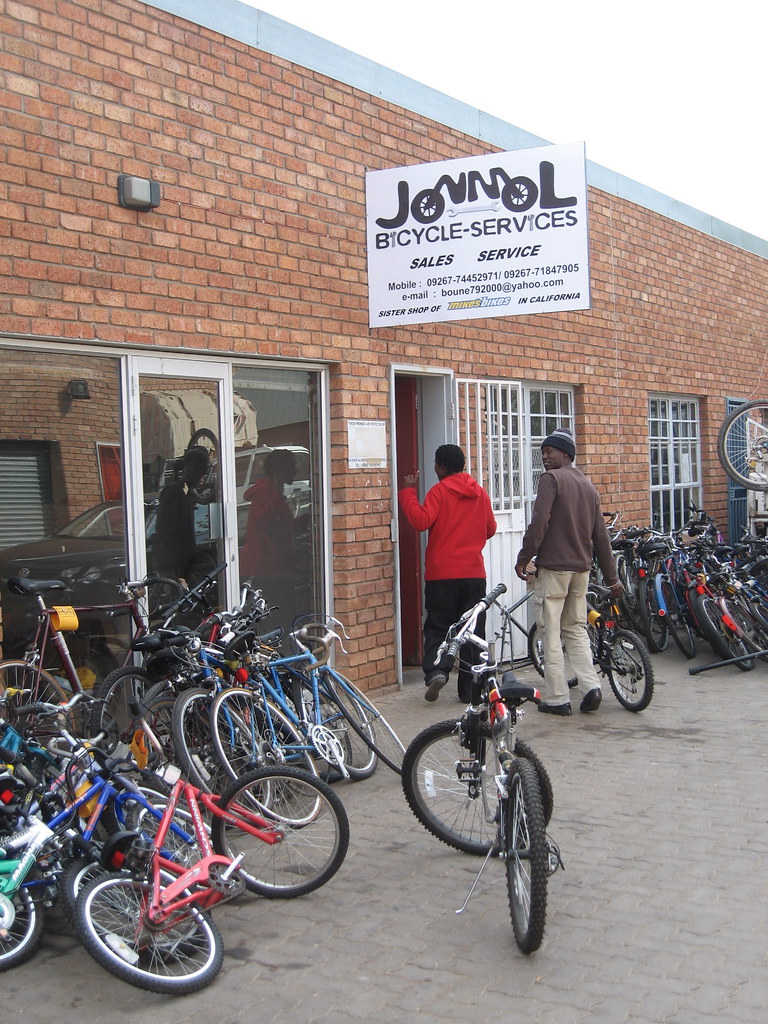
Bones' shop was located inside a private alley of sorts off of a busy one-way street in a bustling commercial district. And though there were signs everywhere for every kind of business imaginable, Jonmol had no sign that was at all visible from the street. Once we pulled into the alley, I finally saw the sign that I'd seen in so many pictures before. But if I were a passerby. . . well, I'd have just passed on by.
When we arrived at the door of the shop, I was impressed by the large glass windows that let sun into Bones' front room, they were huge, just like the windows in the fronts of our shops. The problem was that they were also completely empty. There were no shiny bikes to entice folks that were walking by, or even to let them know what Jonmol was selling at all.

Bones welcomed us warmly and introduced us to his crew. He had three employees who all met us with big warm smiles: Jerry, who was essentially his right hand man, and two mechanics, Tambudzaxi, and Tshepo.
While touring Bones' shop, I was pleasantly surprised with the layout and size of the place. The front room was a nice, light, and airy spot with a tall counter and a wall of parts and accessories behind it.

While the floor space in front of the front windows was troublingly empty, there were a handful of partially-built kids' bikes against the brick wall. I really got a kick out of the printed photos that were up in the front room—the staff and some local bicycling events were represented, and there were even a few from when we brought Bones to California last December.

The back room and workshop presented some more challenges, and luckily, some bright spots too. It was quite big, but dark, with just some small windows on one wall and relatively poor fluorescent lighting. There were quite a few bikes around, both hanging from the ceiling, and neatly stacked in rows against each other, with a loose system of organization. It included the standard bike shop breakdown: Bikes that were awaiting work, awaiting parts, completed repair bikes, and new ones for sale (most only partially built, however).

The workshop area had a nice counter with display shelves underneath (sporting messy piles of parts and accessories inside them). It had two workstands that were being used a bit differently in orientation than we tend to use in the U.S., and there were lots of seemingly random parts all over the workbench, shelves, and on cardboard sheets on the ground.

One of the highlights for me was their wheel truing stand, which was simply the chopped rear triangle of a bike frame that could be placed in a workstand. The wheel to be straightened was bolted into the frame and the brakes were used to as a reference point for adjusting the spoke tension to true the wheel. A loosely organized tool wall, which seemed to have all of the basics covered, completed the work space.

The last bit of our tour of Bones' shop was the electric-blue-painted office off the front room. Like many other things here, it was both very basic and surprisingly modern, with a simple desk and a few chairs. Not much else was there other than some papers and ledgers and the small netbook-style computer we provided him with last year. And Bones' personal bike was in the office, a nice black GT Avalanche with Shimano Deore components. It looked clean and well maintained, the type of bike that you could tell the man takes pride in. We could relate.
For those of you that weren't tuned in last year, we established Jonmol Bicycle Services with Jon "Bones" Moletsane in Gaborone, Botswana, with a lot of hard work, a lot of investment, and 404 bicycles generously donated from our customers. Though Ken and Matt were in Gabs to help Bones create the shop last year, this was the first time they had been back since, and of course it was the very first time I had ever seen the shop.
What struck me initially about Jonmol was nothing. Literally nothing at all.

When we arrived at the door of the shop, I was impressed by the large glass windows that let sun into Bones' front room, they were huge, just like the windows in the fronts of our shops. The problem was that they were also completely empty. There were no shiny bikes to entice folks that were walking by, or even to let them know what Jonmol was selling at all.

While touring Bones' shop, I was pleasantly surprised with the layout and size of the place. The front room was a nice, light, and airy spot with a tall counter and a wall of parts and accessories behind it.


Saturday, November 7, 2009
Gabs needs bikes
Gaborone, Botswana is a place of many contradictions, and this is what fascinated me most over the brief time that I spent there. These contradictions really hit home as we crossed town on our way to Bones' shop.
 In the space of a half-hour drive, we passed through entire neighborhoods of corrugated metal shacks and dirt roads with chickens and children playing in the dust. There were shells of stripped cars on the sides of these roads, and everywhere there were people walking. And walking, and walking, and walking, sometimes with their burdens of goods balanced impossibly on their heads.
 Yet directly adjacent to these places were areas of dramatic development and, frankly, consumerism gone wild. There were strip malls, indoor malls, car dealerships, and billboards everywhere in Gabs. Many of the residential neighborhoods looked like lower middle class U.S. suburbs in fact, and there was, to me, an almost shocking amount of construction going on. All over the city there were buildings and roads being built. Development in Gabs was very clearly on the rise.
 A side effect of this situation that was extremely relevant to our mission was the traffic. Some of the traffic jams we encountered, particularly when you compare them to the lack of population density, were just horrendous. It could easily take an hour to go 10 miles at the wrong time of day. And the lines for the combi transporters, which are privately owned vans that serve as public transit in Gabs, sometimes stretched for hundreds of yards (or meters, as it were). These lines were where people waited to pack into the combis and sit in traffic just like we were doing. With public transit in this kind of state, it quickly became clear why there were so many people walking everywhere. Despite the fact that the city of Gaborone is very low-density and very spread out—meaning that it would probably take a very long time to get where you're going—there were always throngs of people walking from place to place.
One thing we saw almost none of, until we arrived at Bones' shop, were people on bicycles. And yet, the city was in many ways so utterly ready for this most perfect form of transportation. Almost all of the major thoroughfares were wide enough to allow bicycle traffic alongside the cars. In addition, there was an entire network of dirt paths along all of the major routes where people were walking. Most of these paths were easily wide enough to share with bikes. And unlike, say San Francisco, the city of Gaborone is utterly flat. One could ride across town to work without sweating any more than they would on an easy stroll.
It was crystal clear to us that so many people here could have their lives completely transformed by a simple bicycle, and we needed to help Bones make that happen.
Thursday, November 5, 2009
If you're trying to clear customs in Gaborone, Botswana with several boxes of bicycle parts, you may want to budget more time than your flight took.
Literally.


The turbo-prop flight (a little bumpy for my already-queasy stomach, thanks) from Jo'burg to Gaborone took a little over an hour.
Clearing customs took almost three.
We were quite thankful that our checked bags along with all four boxes of much-needed supplies that we brought for Jonmol Bicycle Services made all three of our flight legs and arrived safe and sound in Botswana's one-room and non-air-conditioned airport. Little did we know, however, getting them into the airport would prove to be much easier than getting them out.
Our two customs agents were understandably baffled when we insisted that the contents of our boxes were a donation of bicycle parts, since they really had no idea who the heck would need or want bicycle parts in Gabs (as Gaborone is affectionately known to locals).

What made the process drag on for hours was that the agents, really just trying to do their jobs, insisted on counting and cataloging every single thing we brought in. This gets to be pretty challenging when you have to explain things like what a replacement bicycle handlebar grip is used for. It was also an eye-opener for me as to how "official" things work in this part of Africa. Nothing is rushed or formal in any sort of authoritative way like it would have been as a U.S. airport, and there was lots of back and forth banter and certainly some, let's say fudging, of the numbers here and there.
Once all of the boxes were opened, unpacked, counted (including hundreds of inner tubes), the haggling began. Since the purpose of the goods and our mission didn't really fit neatly into any of the Botswana standards for customs charges, duties, VAT fees and the like, Ken and Matt had some negotiating to do. After going round and round at the counter with our friendly agents, they ended up having a sit-down in the customs office (more of a walk-in closet really).

After at least another half hour of discussion, everyone emerged weary but smiling. The charge ended up at 10% of the value of our donated bike parts, dutifully "estimated" by the customs staff. While it was no paltry sum in the end, it could have been higher even than the wholesale price we paid for the parts and accessories in the first place, which wouldn't have gotten a smile from Ken or Matt, that's for sure.
Tuesday, October 27, 2009
So, What's the Plan Anyway?
It's simple, really.

All we need to do is fly to Gaborone, Botswana (by way of New York and South Africa), meet up with Bones at his shop Jonmol Bicycle Services (the first Mike's Bikes African Sister Shop), find out what challenges he is having in providing bicycles to his community, solve them all, and help him prepare to receive the next container of 400 bicycles (generously donated by our customers) which is nearly ready to ship out from our warehouse in San Rafael, California. All in the space of about three days, give or take.
Then all we'll have left to do is fly to Windhoek, Namibia to meet up with our indispensable helper-on-the-ground Kami and pow-wow with the Bicycle Empowerment Network while we're there. The next day we'll drive 10 hours across the Kalahari Desert to the village of Divundu. There we will meet Erasmus and Ludwig, and hopefully the container of 466 donation bicycles that we shipped out two months prior, but which has encountered the bad luck of a cargo ship breakdown, and will, fingers crossed, be arriving in Divundu right about when we are. We'll then unload the container as it will be used as the space for Erasmus and Ludwig's Sister Shop. Oh, and we'll have to build and tune the bikes, teach Erasmus and Ludwig how to service bicycles and how to effectively run a bike shop top-to-bottom, and establish supply lines for consumables like tubes and chains. And we'll have a whole 9 days to do it, give or take.
What could possibly go wrong?
Then all we'll have left to do is fly to Windhoek, Namibia to meet up with our indispensable helper-on-the-ground Kami and pow-wow with the Bicycle Empowerment Network while we're there. The next day we'll drive 10 hours across the Kalahari Desert to the village of Divundu. There we will meet Erasmus and Ludwig, and hopefully the container of 466 donation bicycles that we shipped out two months prior, but which has encountered the bad luck of a cargo ship breakdown, and will, fingers crossed, be arriving in Divundu right about when we are. We'll then unload the container as it will be used as the space for Erasmus and Ludwig's Sister Shop. Oh, and we'll have to build and tune the bikes, teach Erasmus and Ludwig how to service bicycles and how to effectively run a bike shop top-to-bottom, and establish supply lines for consumables like tubes and chains. And we'll have a whole 9 days to do it, give or take.
What could possibly go wrong?
Subscribe to:
Posts (Atom)


